
Des’ree, 1994
Have got to, the modal verb of necessity meaning have to, is routinely pronounced gotta, a fact that sometimes merits just a footnote in grammar textbooks. However, deleting the word have and pronouncing got to as gotta is so common in informal spoken English that it’s worth practicing. This song is a great introduction to a practical lesson–it repeats the phrase you gotta be dozens of times.
The song has an inspiring message to boot: Des’ree says it’s about having inner strength. She says she thinks every day about how she has to be something: cool and calm and one situation, and then bold and strong in another situation.
This lesson plan works best for levels low intermediate and up.
Choose from the following activities:
- Listening Listen to the audio-only video while reading the lyrics below. Lyrics intended for nonprofit educational purposes only.
- Listening Listen to the audio-only video again. This time, SAY the words in bold when the singer sings them.
- Grammar Practice the pronunciation of got to as gotta with the activity below. Permission granted to reproduce for classroom use.
gotta worksheet.pdf gotta worksheet (webpage)
- Grammar You might want to point out that have got to has no past-tense form and isn’t used in negatives or questions; instead, a form of have to is used. For example: I had to go home, I don’t have to go home, Do you have to go home?
- Listening Watch one of these videos: the official video, a live performance video, or the acoustic cover by two Australian performers.
- Writing / Discussion Students write a paragraph on this topic: The singer says, “You gotta be hard, you gotta be tough, you gotta be stronger.” Do you think it’s important to be hard, tough, and strong? Explain your answer in writing. Then share your answer with a partner or in a small group.
- Reading If you use the True Stories reading series, this song would pair well with a story about resilience: “Try, Try Again,” “Thank You,” “Saved by the Bell,” “A Strong Little Boy,” “The Champion” (True Stories 2); “Everybody’s Baby,” “A Long Fishing Trip,” “The Surgeon” (True Stories 3); “The Semong,” “How You Finish,” “Flight 5390” (True Stories 4); “The Chef” (True Stories 5); “745 Miles on a Pink Bike (Pop-up Story 1, written at 3 levels).
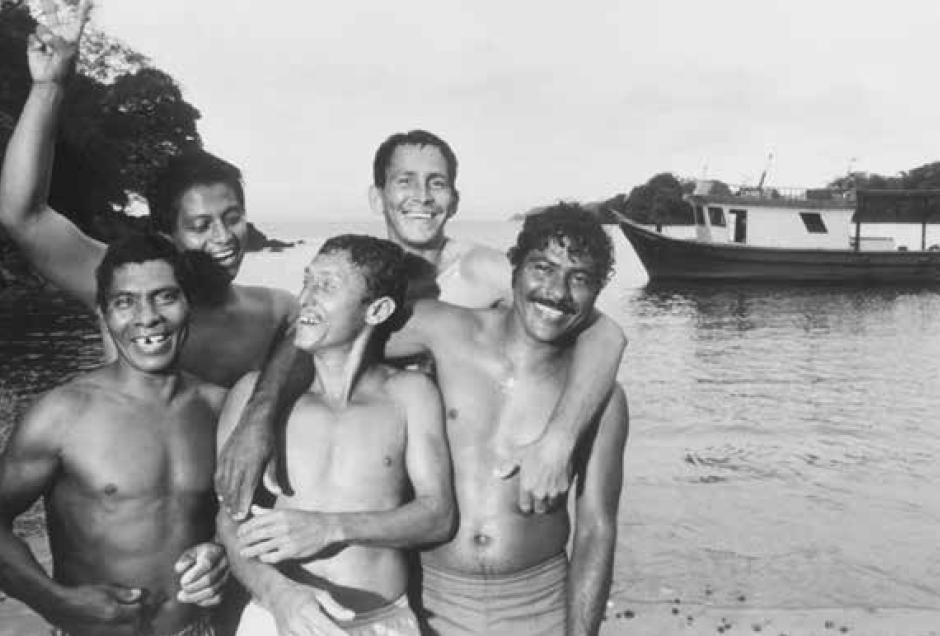
Five tough, strong fishermen (“A Long Fishing Trip,” True Stories 3)
 SONGS AND ACTIVITIES FOR ENGLISH LANGUAGE LEARNERS